
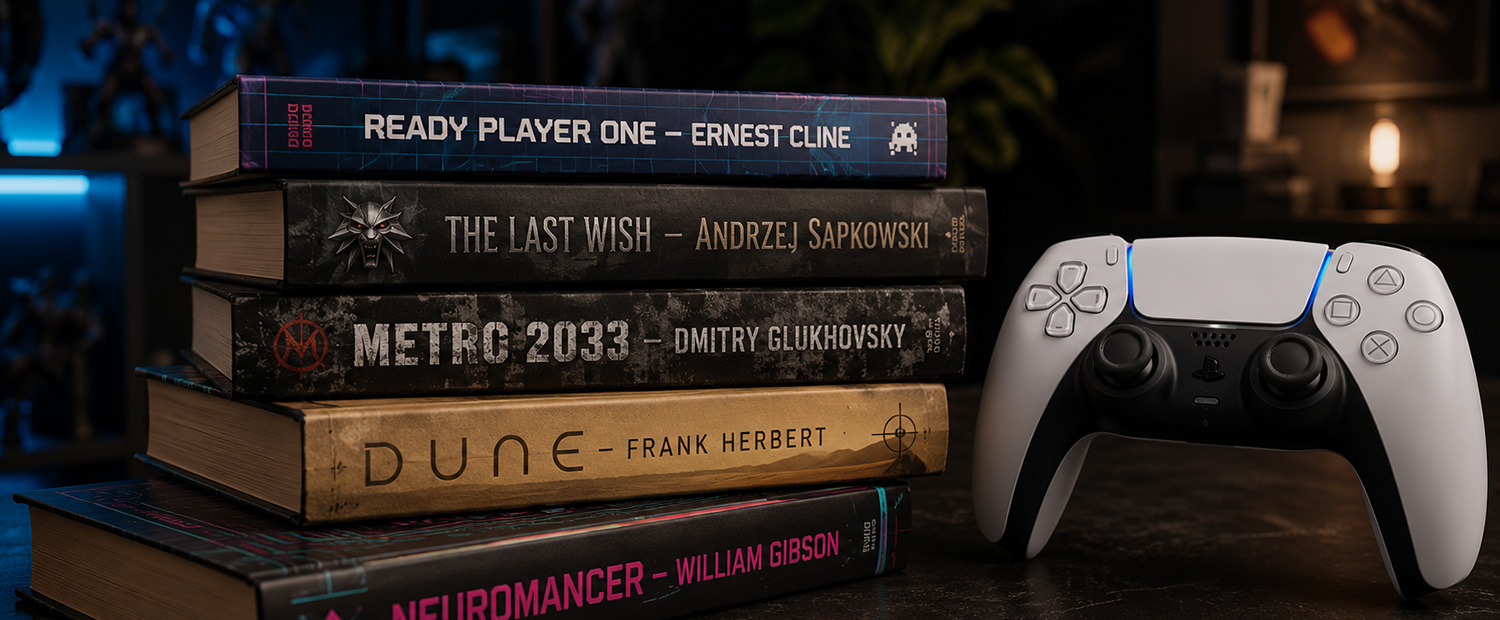

Some books hit like boss fights, side quests, hidden lore, and emotional cutscenes – and these are the ones every gamer should loot at least once.
Gamers don’t only love games because of mechanics. We love worlds. We love progression, atmosphere, danger, strange characters, impossible choices, and that delicious feeling of being pulled into a place that exists somewhere between imagination and obsession. A great book can do the same thing – just without the controller, the loading screen, and the goblin screaming at a checkpoint.
So this is not a dusty school list of “important literature.” This is a cave-approved collection of books for gamers: fantasy, sci-fi, post-apocalyptic nightmares, cyberpunk legends, game development stories, and pure geek fuel. If you are looking for the best books for gamers, books that feel like video games, or just something to read between long sessions in your favorite open world, start here.
Ready Player One by Ernest Cline – pure gaming nostalgia in book form
If there is one book that screams “gamer bait” in the most shamelessly enjoyable way, it is Ready Player One. This is a story about virtual reality, pop culture obsession, hidden clues, digital treasure hunting, and the kind of Easter egg madness that makes completionists start breathing heavily.
Is it subtle? Not really. Does it sometimes feel like someone turned a retro arcade, a movie marathon, and a nerd convention into one giant quest log? Absolutely. And that is exactly why it works for so many gamers. Ready Player One understands the pleasure of knowing useless geek facts that suddenly become extremely useful when the right puzzle appears.
For a gamer, this book feels like jumping into a massive online world where every reference is loot and every chapter has another locked door waiting for the right key. The goblin in me respects that. A book that turns obsession into a weapon? Delicious.
The Last Wish by Andrzej Sapkowski – monster hunting with moral damage
Before The Witcher became a legendary game series, Geralt of Rivia was already wandering through strange lands, taking contracts, drinking potions, getting judged by peasants, and discovering that monsters are often less monstrous than people. The Last Wish is the perfect starting point because it introduces the world through sharp, memorable stories rather than dropping you into a giant fantasy brick.
For gamers, this book is almost unfairly easy to love. It has quests, monsters, taverns, cursed nobles, dangerous women, dark humor, and moral choices that rarely give you a clean “good ending.” It feels like the DNA of a great RPG before the RPG even loads.
What makes it special is that Geralt is not just a fantasy hero with a sword. He is a tired professional in a broken world, trying to do his job while everyone argues about destiny, politics, and who deserves to be called a monster. If you love RPGs where every decision leaves a stain, this is mandatory reading. Bring silver. Bring steel. Bring patience for humans, because they are usually the worst mobs.
Metro 2033 by Dmitry Glukhovsky – post-apocalyptic tunnels and nightmare atmosphere
Metro 2033 is basically a survival horror game trapped inside a novel, and I mean that as the highest cave compliment. Humanity hides underground in the Moscow Metro after nuclear disaster, and every station feels like its own faction, village, bunker, or cursed checkpoint. Above the tunnels, the surface is deadly. Inside the tunnels, people are somehow not much safer.
For gamers, the appeal is immediate. This book has the structure of a dangerous journey through hostile zones, with each station bringing new threats, beliefs, politics, monsters, and psychological pressure. It feels like moving through levels, except the loading screen is replaced by damp concrete and dread.
The atmosphere is the real beast here. Metro 2033 doesn’t just say “post-apocalyptic.” It smells like rust, old fear, cheap filters, and bad decisions. If you love games where the world itself feels like an enemy – like S.T.A.L.K.E.R., Fallout, or the Metro games themselves – this book belongs in your backpack.
Dune by Frank Herbert – the ultimate strategy game disguised as a novel
Dune is not just a sci-fi classic. It is a giant political sandbox full of factions, resources, religion, ecology, prophecy, betrayal, and long-term strategy. In other words, it is basically what would happen if a grand strategy game swallowed a desert planet and started whispering about spice.
For gamers, Dune is fascinating because it teaches you to think in systems. Arrakis is not just a location. It is a resource economy, a battlefield, a religious symbol, a survival environment, and a political prize all at once. Every character is playing a different game, and most of them are willing to sacrifice someone else’s entire army to win.
This is a book for players who love deep worldbuilding, faction politics, and stories where power is never simple. It is not always an easy read, but it rewards attention. Like a proper strategy game, Dune makes you feel small at first – then slowly teaches you the rules of the board. Just don’t trust anyone offering a nice diplomatic conversation. That is how you get poisoned, stabbed, or turned into someone’s tutorial objective.
Neuromancer by William Gibson – cyberpunk before cyberpunk became wallpaper
If you love cyberpunk games, neon cities, hackers, megacorporations, body mods, AI, and people with very expensive emotional problems, Neuromancer is essential. This is one of the books that helped define the cyberpunk mood long before it became a common visual preset in games.
For gamers, Neuromancer feels like stepping into the source code of an entire genre. You can feel its shadow in countless worlds: dirty cities, digital heists, corporate gods, broken people, and technology that looks cool right up until it eats your soul. It is not cozy sci-fi. It is sharp, weird, stylish, and sometimes intentionally disorienting.
That disorientation is part of the charm. Neuromancer does not hold your hand. It throws you into the neon mud and expects you to crawl forward. My goblin brain appreciates that kind of disrespect. If a book makes me feel like I accidentally installed illegal software into my skull, I consider that a feature.
The Lord of the Rings by J.R.R. Tolkien – the original party-based fantasy campaign
Every gamer who loves fantasy should read The Lord of the Rings at least once, not because it is “important,” but because so much of gaming fantasy is still walking in its footprints. The party. The map. The ancient evil. The journey. The ruined kingdoms. The magical items. The feeling that the world is older, sadder, and bigger than the hero.
For gamers, this is the ancestor of a thousand RPG campaigns. The Fellowship is basically a party with different classes, strengths, weaknesses, and emotional side quests. The journey has zones, danger levels, lore drops, boss encounters, stealth sections, cursed items, and a final objective that looks impossible from the start.
But the real magic is atmosphere. Tolkien makes the world feel lived-in beyond the page. You don’t just read about Middle-earth – you travel through it. And like the best open-world games, it keeps suggesting there are more ruins, more songs, more histories, and more monsters just outside the path. That is worldbuilding treasure. Goblin-approved, even if the goblins in the book are having a significantly worse time.
Jurassic Park by Michael Crichton – survival horror with teeth, science, and bad corporate planning
Jurassic Park is much more than “dinosaurs escape and people run.” It is a techno-thriller about control, arrogance, systems failure, and the ancient truth that rich people should not be allowed to build theme parks with murder lizards. As a gamer, it reads like a survival-horror scenario where the map is gorgeous, the security system is failing, and every enemy has better teeth than you.
The book is especially great for players who love games where the disaster is caused by human stupidity as much as the monsters themselves. The dinosaurs are terrifying, yes, but the real horror comes from the illusion of control falling apart. Doors stop being safe. Fences stop being reliable. Plans stop being plans.
It has tension, chase sequences, scientific flavor, and that wonderful feeling of watching a perfect system collapse into chaos. Basically, it is a cautionary tale for anyone who has ever played a management game and thought, “What if I cut corners to save money?” Congratulations. You are now the villain.
The Martian by Andy Weir – survival crafting, but with potatoes and science
The Martian is one of the most gamer-friendly books ever written, even though it is not about games at all. A man is stranded on Mars and has to solve problem after problem using science, stubbornness, and a sense of humor that refuses to die. That is survival crafting. That is resource management. That is “I have three broken systems and a potato, let’s build a future.”
For gamers, the pleasure is in the loop. Problem appears. Resources are limited. The environment is hostile. The protagonist tests a plan, adapts, fails, improvises, and keeps going. It feels like watching someone play a brutally realistic survival game with permadeath enabled.
What makes it so readable is the voice. The book is technical without becoming cold, funny without ruining tension, and optimistic without being soft. Mark Watney is basically the kind of player who refuses to quit a hard mission because “there has to be a way.” Every gamer knows that feeling. The goblin version usually involves yelling at the screen, but spiritually, it is the same.
Blood, Sweat, and Pixels by Jason Schreier – the brutal reality behind the games we love
If you play games, you should know how they are made. Blood, Sweat, and Pixels is one of the best books for pulling back the curtain on game development without turning it into a boring corporate slideshow. It tells the stories behind difficult, messy, ambitious projects and shows how close many games come to falling apart before they ever reach us.
For gamers, this book is important because it changes how you look at the medium. Suddenly, every polished menu, delayed release, strange design choice, cut feature, and miracle launch has a human cost behind it. Games are not created by magic goblins in a basement – sadly, I checked. They are built by exhausted teams solving impossible problems under pressure.
It is also a perfect read for anyone who complains about games online, which means all of us. After reading it, you may still criticize games – and you should – but you will probably do it with a little more respect for the chaos behind the screen. The loot did not spawn itself.
Masters of Doom by David Kushner – the origin story of gaming rebellion
Masters of Doom is essential reading for anyone who loves PC gaming, shooters, mod culture, or the idea that a few obsessed people can change an entire medium. It tells the story of John Carmack, John Romero, id Software, Doom, Quake, and the wild era when game development felt like punk rock with keyboards.
For gamers, this book has everything: ambition, genius, ego, friendship, conflict, creative obsession, technical breakthroughs, and the beautiful madness of people building something that feels impossible until it suddenly exists. It is not just about one company. It is about a moment when games became faster, louder, darker, more moddable, and more culturally dangerous.
What makes it so fun is the energy. You can feel the speed of that era – late nights, code, pizza, arguments, and ideas that would later shape entire genres. If Blood, Sweat, and Pixels shows the modern struggle of making games, Masters of Doom shows the chaotic origin myth of people smashing the walls down and building a new dungeon behind them.
Final thoughts from the cave
The best books for gamers are not only books about video games. They are books that understand the same things games understand: worlds, systems, conflict, atmosphere, discovery, survival, choice, and obsession. Sometimes they feel like RPG quests. Sometimes they feel like survival horror. Sometimes they feel like strategy games, cyberpunk missions, or developer diaries written in blood, caffeine, and bad sleep.
That is why this list jumps between fantasy, sci-fi, post-apocalyptic fiction, survival stories, and real game development history. A gamer’s brain is already trained to explore strange worlds – books just give us another kind of map.
So put the controller down for one evening, light the torch, open the cave library, and pick one of these up. The screen can rest. The adventure does not have to.
And if anyone says reading is boring, tell them Gob said this: they are simply choosing the wrong quests.


